
Which print process fits your box?
A fine line on a perfume carton and a bold mark on a brown shipping case place different demands on the press. Send the artwork, the board you have in mind and the quantity for each version. We’ll confirm a suitable route in the quote.
Compare Pantone and CMYK ↗Offset lithography
A press transfers ink from a plate via a blanket onto a flat sheet. A smooth cover sheet can then be wrapped around rigid board or laminated to corrugated board. This gives illustrations, gradients and small type a smooth print surface.
Ask about setup per artwork version, the intended stock and how the image crosses a wrapped corner.
Digital printing
There’s no plate to change between artwork versions. It’s worth comparing for short runs or a kit with several sleeves. Confirm the sheet material, whether the final run uses the same process as the proof, and how a large solid colour will look.
Send the quantity for each design. Five sleeves with 100 of each need a different estimate from 500 identical sleeves.
Flexography
A flexible plate can put a bold logo or repeat pattern directly onto a corrugated liner. Brown kraft becomes part of the colour you see. If the design relies on pale colours or fine lines, compare an ink drawdown on kraft with a white liner.
Ask about the number of ink colours, plate charges and the smallest detail that will hold on the proposed board.
Brand colour and repeat orders
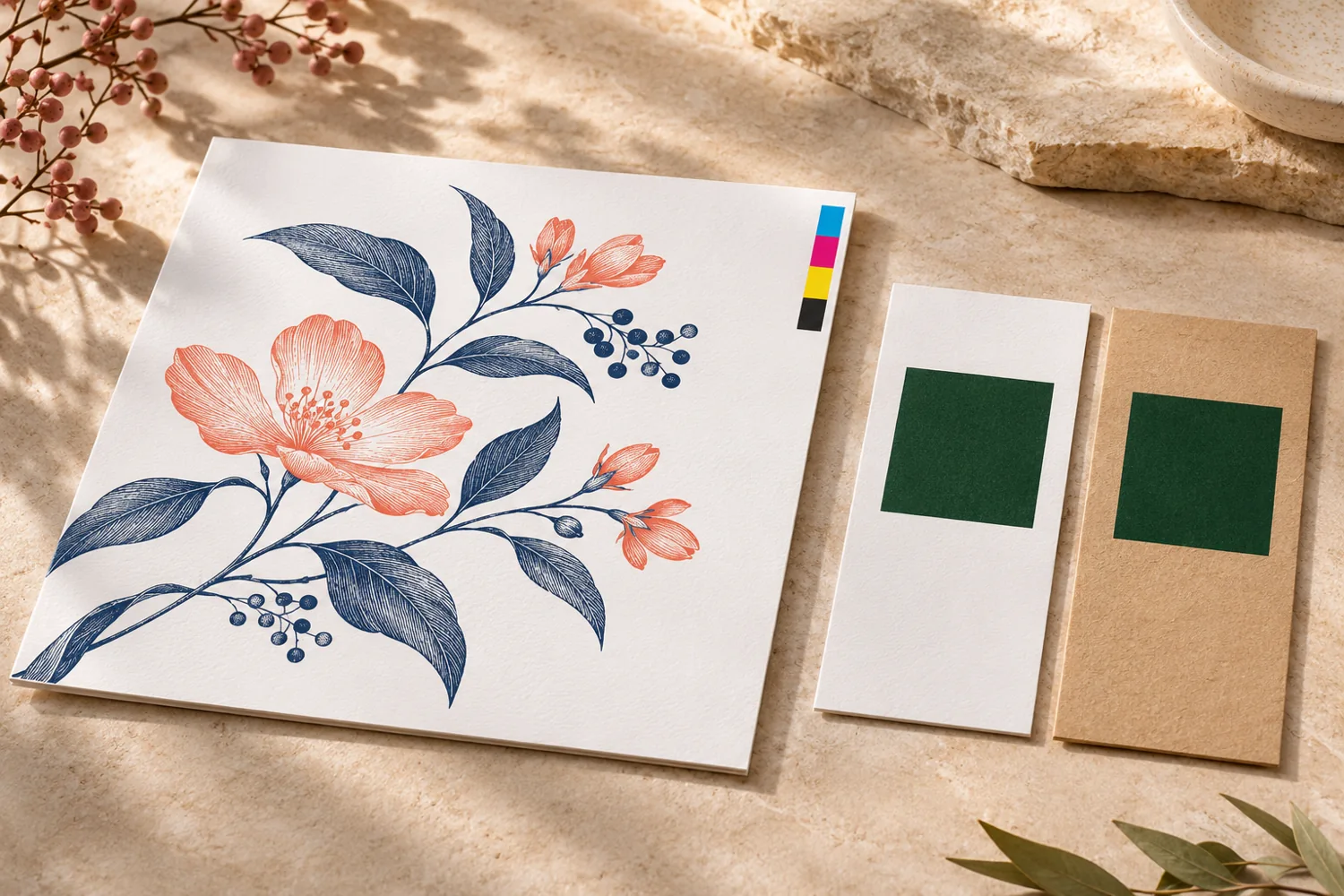
CMYK builds pictures from four process inks. A spot ink is mixed to a specified colour. If the logo colour matters, send a physical reference or a Pantone reference with its coated or uncoated designation.
Review a proof on the intended stock, under the same light as the reference. A digital layout can settle artwork position. To sign off a foil or a deep green solid, use a physical sample that includes the relevant process and finish. Record the approved sample ID for the next run.
Foil, relief and coating
Foil adds a reflective surface. Embossing raises a motif and debossing presses it in. A film or varnish changes the surface sheen. Supply a separate artwork layer for each effect and name the panels it covers.
Fold the printed sample, run a finger along the creases and look at the smallest lettering. See the illustrated surface guide ↗